
Navigating the Deeper Realities of Dementia Care
Dementia extends far beyond simple forgetfulness; it is a progressive journey that profoundly alters how an individual perceives and interacts with the world. Providing a deep level of care requires more than just physical supervision—it demands a profound emotional understanding of how the mind changes and how to lovingly adapt to an individual's shifting reality.
Decoding the Unspoken Language of Dementia
In the middle and later stages of memory loss, individuals often feel confused or frustrated when they cannot make sense of their surroundings. When words fail, behavior becomes their primary language.
Actions like anger, wandering, hoarding, or compulsive habits are often expressions of internal distress. Even seemingly unusual behaviors have a root cause:
Removing Clothing Inappropriately:
Refusal to Shower or Step into Water:
Experiencing Past Hallucinations:
Deep-level dementia care never views these moments as misbehavior; instead, caregivers give time, reassurance, and calm in the exact amounts needed to restore a sense of security.

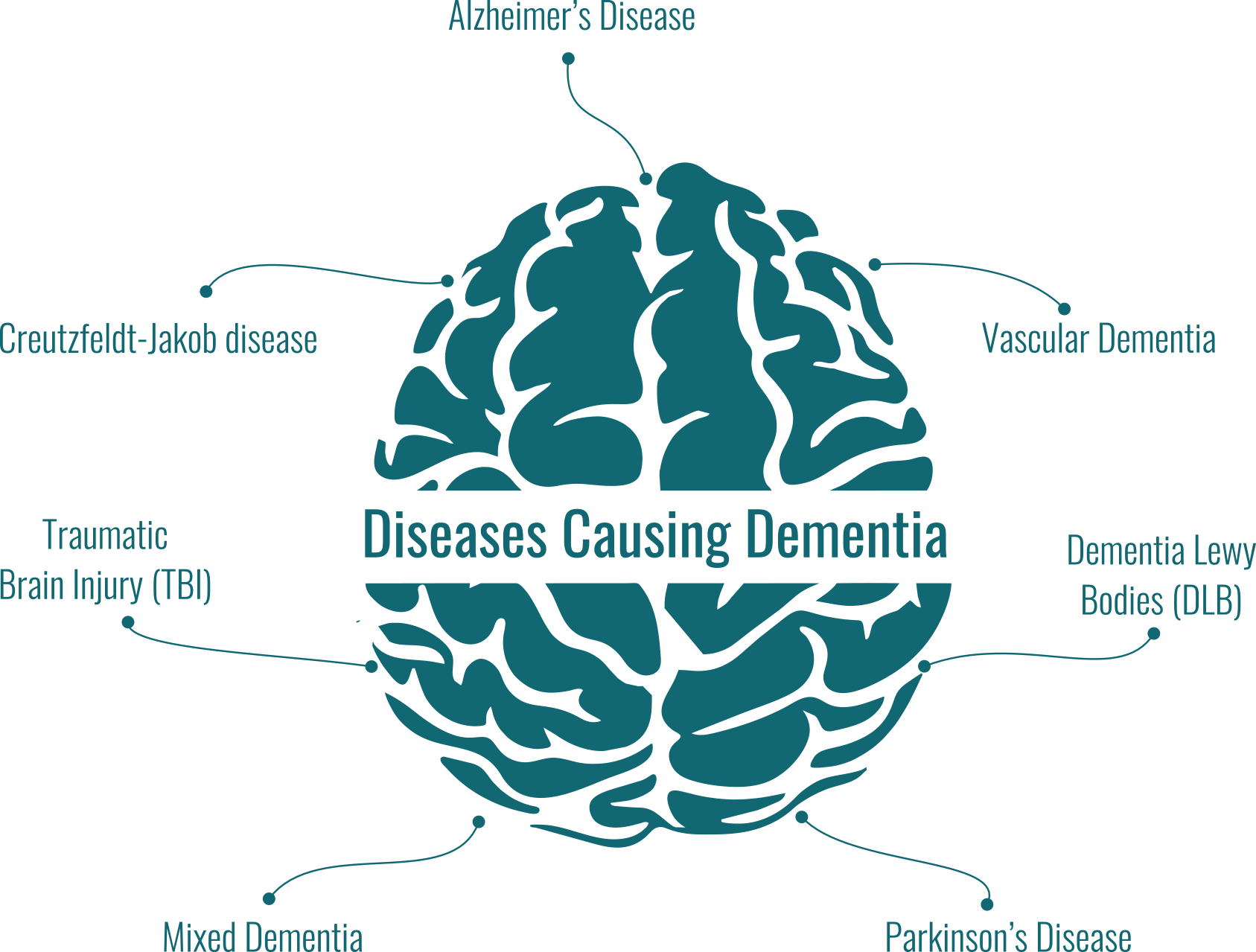
Diseases Causing Dementia: An Umbrella Overview
Dementia is not a single condition, but an umbrella term for progressive neurological diseases including Alzheimer’s, Vascular Dementia, Dementia with Lewy Bodies, and Parkinson's. Each impacts distinct brain lobes and requires specialized, nuanced support.
Explore the Complete Diagnostic Guide & Diagram
Curating a Soothing, Sensory Environment
An individual’s private home is often limited in terms of the nuanced adaptations required for advanced memory care. A dedicated environment utilizes precise sensory interventions to soothe the mind and reduce anxiety.
Research on Color Interventions
Research shows that individuals with dementia respond best to specific colors like calming blue and soft teal, which have a deeply soothing effect that makes spaces feel cooler, lowers sensory overstimulation, and can even help lower blood pressure.
Proactive Comfort for “Sundowning”
Sundowning is a distressing symptom where confusion and agitation worsen in the late afternoon and evening hours. To proactively comfort residents experiencing sundowning, our caregivers implement proven holistic protocols:
- Maximizing Natural Sunlight: Encouraging morning and midday daylight exposure to reset circadian clocks.
- Limiting Daytime Naps: Structuring midday hours with gentle creative hobbies to promote peaceful night sleep.
- Gentle Physical Movement: Supervised garden strolls to naturally alleviate muscular restlessness.
Sustaining Identity Through Purposeful Engagement
Deep care means recognizing that a person's core identity remains, even as their cognitive abilities change.
Isolation is a critical issue that leads to profound loneliness in the elderly, making tailored social activities essential. We focus on keeping individuals happy, engaged, and as independent as possible through activities that resonate with their personal history.
Whether it is looking through childhood photo albums, listening to familiar music, gardening, or participating in simple, familiar routines like folding clothes, these sensory moments help residents feel connected to their past and grounded in the present.
Meaningful Routine Examples
- Personalized memory scrapbooks reflecting lifelong careers and family journeys
- Gentle indoor flower arranging and sensory leaf-rubbing
- Familiar tactile tasks that offer a feeling of genuine contribution and accomplishment

The Power of Compassionate Connection
Even when vocabulary is lost, the human need for connection and dignity never fades. Caring with profound respect allows the affected person to retain as much of who they were as possible, wiping away fear for both the individual and their family.
Our caregivers utilize deeply empathetic communication techniques, understanding that all rules of courtesy still apply. By holding a resident's hand, gesturing gently, and always calling them by their name to reinforce their sense of individuality, we ensure that every person is surrounded by solidarity, warmth, and unconditional love through every stage of their journey.
Rules of Courtesy Still Apply
Our caregivers utilize deeply empathetic communication techniques. We always speak with gentle tones, maintain polite eye contact, and avoid condescending language.
Honouring Individuality by Name
By holding a resident's hand, gesturing gently, and always calling them respectfully by their name, we constantly reinforce their sense of individual identity and worth.
Warmth at Every Stage
We ensure that every person is surrounded by solidarity, warmth, and unconditional love through every stage of their memory care journey, bringing profound relief to families.